With
The Hero of Ticonderoga
|
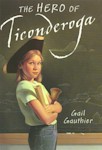 Ethan
Allen was an Eighteenth Century man, and by expanding on what Thérèse has to say about
his life teachers can explain the religious and philosophical movements that shaped him as
well as some of the issues of his day. Religion, philosophy, etc. explain why people
behaved the way they did. Ethan
Allen was an Eighteenth Century man, and by expanding on what Thérèse has to say about
his life teachers can explain the religious and philosophical movements that shaped him as
well as some of the issues of his day. Religion, philosophy, etc. explain why people
behaved the way they did.
Speaking of behavior, why did Ethan Allen have so much trouble getting
along with others? Could religion and philosophy have had anything to do with
that? Well, yes they could.
Watch me speak
about Ethan Allen, The Hero of Ticonderoga, and some of the topics below at the Ethan
Allen Homestead, Burlington, Vermont. |
Puritans:
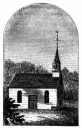 It all goes back
to the Puritans who are certainly as dull a crowd as any grade school student could ever
hope to encounter. They dominated Connecticut and Massachusetts during the century prior
to Ethan's birth in 1738. The Puritans were members of a religious group that believed the
Church of England needed to be 'purified' of its pomp and ceremony as well as its
dependence on a leadership of bishops who were placed above other church members. The
Puritans came to America believing they were bringing true Christianity with them. They
believed in the Bible as the only means of understanding the word of God, original sin
(which means that all humans are born in sin they inherited from Adam and Eve), and
predestination (which means that humans' ultimate fate --whether they will be saved or
damned--is determined before birth and can't be changed). In Puritan New England, the
church didn't run the government, but the government supported the church. Tax money was
used to pay ministers, and missing church, failing to observe the Sabbath, and profanity
were all punishable offenses. In an earlier period, nonbelievers were expelled and at one
point in the Massachusetts Bay Colony only Puritans were allowed to become settlers in the
first place. It all goes back
to the Puritans who are certainly as dull a crowd as any grade school student could ever
hope to encounter. They dominated Connecticut and Massachusetts during the century prior
to Ethan's birth in 1738. The Puritans were members of a religious group that believed the
Church of England needed to be 'purified' of its pomp and ceremony as well as its
dependence on a leadership of bishops who were placed above other church members. The
Puritans came to America believing they were bringing true Christianity with them. They
believed in the Bible as the only means of understanding the word of God, original sin
(which means that all humans are born in sin they inherited from Adam and Eve), and
predestination (which means that humans' ultimate fate --whether they will be saved or
damned--is determined before birth and can't be changed). In Puritan New England, the
church didn't run the government, but the government supported the church. Tax money was
used to pay ministers, and missing church, failing to observe the Sabbath, and profanity
were all punishable offenses. In an earlier period, nonbelievers were expelled and at one
point in the Massachusetts Bay Colony only Puritans were allowed to become settlers in the
first place.
|
The Great Awakening:
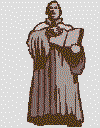 By the
beginning of the Eighteenth Century, the Puritan influence was beginning to decline. Then,
soon after Ethan's birth, a revival occurred known as the Great Awakening. During this
period dynamic, forceful ministers frightened their audiences with dramatic accounts of
the damnation that awaited them. Church members often became hysterical and experienced
some sort of conversion. By the
beginning of the Eighteenth Century, the Puritan influence was beginning to decline. Then,
soon after Ethan's birth, a revival occurred known as the Great Awakening. During this
period dynamic, forceful ministers frightened their audiences with dramatic accounts of
the damnation that awaited them. Church members often became hysterical and experienced
some sort of conversion.
Now we can get back to Ethan Allen and Thérèse LeClerc:
"His parents were oddballs," Tess says in one
of her reports. "They believed that God allowed people to make decisions for
themselves..." pg. 80
The people who considered Ethan's parents oddballs were of Puritan descent
and still maintained many Puritan beliefs, which, remember, had just been rekindled
because of the Great Awakening. However, not everyone appreciated the renewed religious
passion. In fact, towns in New England divided over the Great Awakening. According to
Michael Bellesiles in Revolutionary Outlaws, most people in the town of
Litchfield, Connecticut, where the Allens lived, supported the new ministers with their
emotional focus on the traditional Puritan interest in damnation. Ethan's father was among
the minority that didn't. Nor did he believe in original sin and predestination. So Ethan
was taught religious ideas that didn't conform to those of the community his family lived
in. Since communities in New England had a tradition of expecting a lot of religious
agreement, the stage was set for conflict before Ethan got out his front door.
But that's not all that was going on. |
The Enlightenment:
 "They
used to read a lot," Tess says in that same report. "...stuff
about how there are laws that aren't laws, but they're still laws and people know these
laws..." p.84 "They
used to read a lot," Tess says in that same report. "...stuff
about how there are laws that aren't laws, but they're still laws and people know these
laws..." p.84
Tess is talking about natural law, an idea that became popular during what
is known as The Age of Enlightenment or The Age of Reason--or the Eighteenth Century,
Ethan's century. Though Ethan was not able to finish his formal education, he continued to
read and was exposed to the writings of the Enlightenment's philosophers through the
efforts of the friend Tess mentions, a young doctor. Many of the leaders of the Revolution
were influenced by Enlightenment philosophers. And Enlightenment philosophers were
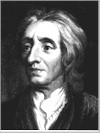
influenced by the writings of John Locke, whose lovely portrait you see to the left.
It was Locke who first said that the world was run according to natural laws and that
humans could reason these laws out for themselves through observation and reason.
"These books said that if your government broke those laws
about right and wrong you should rebel against it. These books said that one of the laws
stated that no one should take the life, liberty, or property of another."
Pg. 85
In the above passage Tess is referring to the work of John Locke.
The Enlightenment encouraged people to apply reason to all things, whereas
the Puritans who had had so much influence on New England society relied on faith. Ethan
came down on the side of reason, therefore setting himself up for more conflict with his
faithful neighbors in Connecticut.
Okay, you may say. But what about the smallpox inoculation? |
Smallpox:
 "Thomas
inoculates Ethan for smallpox--without permission. On a Sunday. In front of a
church." Pg. 86 "Thomas
inoculates Ethan for smallpox--without permission. On a Sunday. In front of a
church." Pg. 86
The smallpox controversy appears to have been a case of Ethan looking for
a fight. Otherwise, why do it in front of a church on Sunday?
The Colonists were terrified of smallpox. In England and Europe, it was a
common childhood disease, according to Daniel J. Boorstin in The Americans: The
Colonial Experience. Children either died or survived and became immune. It
wasn't common among adults. Because it was unknown in America before the Europeans arrived
and because most of the early European settlers were immune adults, the disease never
became common. When it occurred, it occurred as epidemics. (Among Native Americans, the
death rate in some tribes was 90% or more.)
Though smallpox vaccination wouldn't be available until the end
of the Eighteenth Century, at the beginning of the century Europeans found that people in
the East were practicing a form of inoculation against smallpox. Though I didn't
have the information at the time I wrote Hero,
I've since read that one method of doing this was to dry scabs from smallpox victims,
crumble them, and have people inhale them. (Who was the lucky person who got that job?)
This resulted in a milder, more survivable case of the disease.
For many years inoculation was controversial and regulated if not actually
prohibited. (That was the case in Connecticut at the time Ethan got in trouble.) It was
only done when an epidemic was expected because otherwise inoculation was introducing live
virus into a community, and the virus could then spread. In addition, some of those
who objected to the practice raised religious arguments--one should trust in God and not
look to man for help. However, Cotton Mather, one of the most famous Puritan ministers,
supported smallpox inoculation, and Jonathan Edwards, a leading minister during the Great
Awakening and considered one of the greatest of American theologians, died as a result of
a smallpox inoculation.
Ethan was making a political statement by having himself inoculated so
publicly. It certainly couldn't have been an attempt to endear himself to his neighbors.
Years later, while confined to the city of New York by the British, he would learn that
his young son had died of smallpox. The child's death is supposed to have devastated him.
One has to wonder (or I do, anyway), if he had been home would things have turned out
differently?
|
Pigs:
 Smallpox.
Life. Death. Wow. But how do you explain the pig thing? Smallpox.
Life. Death. Wow. But how do you explain the pig thing?
"And he found some loose pigs in his garden, locked them up
in a pen, and had to go to court because he was supposed to lock them up in some special
pig pound." Pg. 88
Hey! Bellisles says the 'pig thing' was the biggest political issue in
Eighteenth Century New England!
Pig owners had been letting their pigs roam around digging up whatever
munchies they could for centuries, and pig owners in the 1700s thought it was still a darn
fine system. The Allens didn't, and for once the majority of their neighbors agreed with
them. In the old country, a lot of the land was owned by a landlord and worked communally
by tenant farmers. But in America, more people owned their own property. We're talking
private property. The average landowner believed he shouldn't have someone else's pigs
damaging his private property.
How did Ethan manage to get in trouble when he seems to have had public
opinion on his side? Because there were rules for what was to be done with roaming pigs.
They were to be placed in a pound or pen maintained by the town. Ethan found eight pigs in
his garden and just locked them up in a privately owned pen. The pigs' owner got mad and
took Ethan to court. And that's why we know this happened--there are court records.
There weren't many courts in the New Hampshire Grants. |
The Frontier:
 "In
fact, when he was living in Massachusetts, a minister once asked him to stop being such a
bad influence on his neighbors. But up in the New Hampshire Grants people actually liked
bad influences." Pg. 125 "In
fact, when he was living in Massachusetts, a minister once asked him to stop being such a
bad influence on his neighbors. But up in the New Hampshire Grants people actually liked
bad influences." Pg. 125
Tess exaggerated a bit. The New Hampshire Grants were located on a
frontier. And frontier society tended to be less strict and formal than the society of
more settled areas.
When we think of a frontier we think of the wild west or the Starship
Enterprise. But a frontier is the land that borders settled and unsettled territory. In
America, as a frontier became settled it was no longer a frontier. The frontier would move
beyond that settled land. At the time Ethan and his family moved up into the Green
Mountains that area was a frontier. There was little in the way of formal law there. There
was no court system. There were few churches. There was less of a need to fit in. People
on frontiers worry about things people in more settled areas don't, such as staying alive.
Ethan's belief in reason over faith wasn't as big an issue in the Grants because the
people there didn't have the time to worry about it. Since the Grantsmen were involved in
a battle, Ethan's tendency to argue wasn't viewed as a handicap. On the contrary, it was
an asset. The farmers needed a spokesman, and Ethan liked to speak.
So long as America had a frontier, there was a place to go where people
like Ethan who couldn't get along in a settled community had a chance to make a better
life for themselves. Like smallpox, the frontier either killed them or made them stronger.
In Ethan's case, it made him stronger. As Tess said, when the Revolution
came there was nothing in the New Hampshire Grants to protect the settlers or help the
colonists except for Ethan and the Green Mountain Boys.
|
Committees
of Correspondence:
 "There were
little groups here and there organizing the colonists in the fight against the
British." Pg. 154 "There were
little groups here and there organizing the colonists in the fight against the
British." Pg. 154
Tess is talking about committees of correspondence. These were groups set up before the
Revolution to coordinate activity, shape public opinion, and communicate between and among
colonies--though if they sent both Ethan and Benedict Arnold to take Fort Ti they may have
been a little weak on coordination and communication. The legislatures of the colonies set
up committees. There were also local ones.
"The Report of the Committee of Correspondence to the Boston Town Meeting,
Nov. 20, 1772" begins with a discussion of the "Natural Rights of the
Colonists as Men." Like Ethan, Samuel Adams, the author of that report,
was into natural law.
To view Samuel Adams' report click here.
The founding fathers were not willing to take natural law as far as Ethan
was, however. |
The Vermont Doctrine, or Who Gets to Create States?
 "As
far as Congress was concerned, there were thirteen colonies, including New York, and its
job was to look out for the rights of those thirteen colonies." Pg. 195 "As
far as Congress was concerned, there were thirteen colonies, including New York, and its
job was to look out for the rights of those thirteen colonies." Pg. 195
As Bellesiles explains it, the Continental Congress only considered a
government (for example, a state government) legitimate or legal if it existed prior to
the forming of the United States. The colony of New York existed prior to the Revolution.
Vermont, as a state or a republic, did not and therefore could not. The Continental
Congress believed a only a government (say the English government, which created the
colonies) could create a state. Ethan and his followers believed the people could create a
state. Thomas Jefferson called that belief the "Vermont doctrine."
This whole argument would become even more important because more than
Vermont was at stake. There was land to the west of the established colonies/states with
populations that were also interested in forming states. Letting Vermont get away with
statehood would set a bad example and encourage others to do the same.
Vermont finally became a state after Ethan's death because the north/south
power struggle that we spent so much time studying in school was already beginning. New
southern states were interested in joining the Union and a new northern state was going to
be needed to provide balance. Vermont was finally welcomed into the U.S. because Congress
needed it to provide that balance, not because it recognized the rights of citizens to
form states. |
Sources:
Michael A. Bellesiles, Revolutionary Outlaws: Ethan Allen and the
Struggle for Independence on the Early American Frontier
Daniel J. Boorstin, The Americans: The Colonial Experience
E. Gherardi, The Concept of Immunity, History and Applications |
|
