Saturday, March 13, 2010

Going Places And Seeing People

Today I finally made it to the Eric Carle Museum of Picture Book Art, in spite of the best efforts of my GPS to keep me from getting there. The New England Society of Children's Book Writers and Illustrators sponsored an event there called Overcoming Challenges. The morning session covered career challenges, and the afternoon session covered what I would call craft or process challenges.

Panelists: Elise Broach, Lita Judge, Grace Lin, and Sara Pennypacker (She has a website, but I couldn't make it open.)

I had lunch with Karen Pandell. She'll be getting a website sometime in the future.

I heard some thought-provoking stuff. Provoking thought is good.

Labels:

Friday, March 12, 2010

I Particularly Liked The Part About Personal Shame Being The Writer's Most Common Accessory

Author Ben Esch (that is the best author photo ever) wrote a blog post called The Journey is the Inn that:

1. Makes Chaucer sound zenny, and

2. Is all too true.

Seriously beginning authors, you'd better like sitting alone with your computer screen in a room piled with paper and junk and collecting research books and professional journals you'll probably never have time to read and trying to avoid letting your teenage kids find out that their after school jobs pay better than yours because that's what Esch is talking about when he says, "Try to enjoy the process of writing."

I'm always complaining because I don't have more time to do those kinds of things.

Labels:

Thursday, March 11, 2010

So Is Starting School Like Dying?


I'm going to admit that I sometimes have trouble grasping what's really going on in books. Sometimes I think too much while I'm reading. Sometimes I don't think enough.

I think I get Garmann's Summer by Stian Hole. I think it's about fear--everybody's scared. I was just left feeling, Well, okay. And?

Garmann is a six-year-old boy who will be starting school soon. The coming event frightens him. Three extremely elderly aunts, who, as illustrated, would probably be his great-great aunts, come to visit. Garmann asks them if they're afraid of anything. He also asks his parents. Each adult is afraid of something. Grown-ups, too, feel fear, and I guess that's supposed to be comforting.

But one of the aunts, it turns out, is afraid of dying, and Mom is afraid Garmann will be hit by a car while crossing the road. And, you know, those fears just aren't on the same level with being afraid of starting school. Okay, maybe I'm not taking Garmann's fears seriously enough. But I think a fear is serious even if it isn't as big a fear as the fear of death. It doesn't have to be on a par with death to be important.

For a much more positive response, check out Fuse #8's review.

I'm guessing the plot for this book began with premise--the idea of a child fearing the unknown of starting school.

Labels: , ,

More On Evil Plots

I found a transcript of an interview on plot at Oz and Ends. Deborah Lynn Jacobs is the author being interviewed. It's a long transcript, and if you skim, you'll need to do a lot of it. But Jacobs talks about starting her books with a premise and then coming up with a character.

In an earlier post I told about Cynthia Lord's workshop presentation in which she gave a talk on a classic plot structure involving giving a character something he or she wants and then creating obstacles to that character getting it. Jacobs' description of starting with a premise involves the question "What if?". She appears to keep asking it throughout the plotting process. "What if?" is another classic method for creating plots. It's probably closer to what I do.

Earlier this month, I considered doing a self-study program here at O.C. that would involve creating scene cards for books I was reading. Yeah. Like that's going to happen. Plus, it would be giving away too much of other writers' work. But what I may try to do here is determine how the plots of books I'm reading are created--do they have plots that are driven by a character's wants and inability to get them or did they begin with a premise?

So you can look forward to that.

Labels: ,

Wednesday, March 10, 2010

How Many Times Have You Thought About This While Reading?

Nathan Bransford had a post recently on Archetype vs. Cliche. I would also throw the word stereotype in there. Also trope and motif.

If writers can claim that they're working with archetypes, that's a good thing because it implies that somehow they're working with the original pattern. Stereotypes, no. I often read that some author's work indicates her knowledge of the tropes of her genre. But if you're using the tropes of your genre, aren't you running the risk of using cliches?

I think what we're talking here is connotation. Some words connote better things than others. Archetype and trope connote something good. Stereotype and cliche connote something bad. I like motif, myself. Motif, as it turns out, is good. Very, very good. You've heard it from me.

But is the author saying she works with motif and maybe archetype enough? Doesn't someone else have to say it, versus saying that you work with stereotype and cliche? Who makes the decision? Do writers get to say to reviewers and readers, "You've got that all wrong! This is not a stereotypical schoolyard bully story. It's archetypical!" Or "No, no, no. I was using the evil mom motif that turns up frequently in children's literature. My character is part of that archetypical pattern!"

I suspect that one person's archetype is another person's stereotype. Tomato/tomahto.

Monday, March 08, 2010

Desire Is The Source Of All Unhappiness And, Possibly, The Source Of All Plots

Cynthia Lord's plot talk on Saturday involved what might be called the classic structure of giving characters something they want and then throwing obstacles in the way of them getting it. The characters overcome the obstacles and, voila, you have a plot and a book. I've heard elementary school teachers talk about a variation of this, advising students to give characters a problem and then give them obstacles to solving the problem.

While I have been trying to generate plot ideas by working out character desires for my recent books, I've always felt uncomfortable with the Wants/Obstacles/Resolution writing plan. I used to think it was formulaic, that you'd end up with one of those inspirational overcoming-adversity things that are all so much alike. But that's not fair because this kind of plot structure would also work for thrillers and mysteries ("I want to find the murderer"), survival stories ("I want to live"), romances ("I want to love somebody"), journey stories ("I want to go home"), and any number of other types of books, depending on the characters' wants. Any plot structure can probably be described as a formula. One person's structure is another person's formula.

A more reasonable reason for being uncomfortable with this plot creating format is the fact that it still doesn't help you come up with the various plot points. What will my character want? What will the obstacles be? Come on. We're still talking about pulling those out of thin air.

On top of that, for some of us a story begins not with a character but with a scene or situation. We may not even know who in that scene is the main character, forget about what he or she may want. I'm into ordinary people finding themselves in extraordinary circumstances. Coming up with a desire for those ordinary people may not be easy because they are in situations they've never been in before. All of a sudden they're supposed to want something?

I am giving this a great deal of thought, and you can be sure I'll be getting back to you on it.

Labels:

Agency And Wholesale Models

I have been vaguely aware of what's been going on over at Amazon relating to the sale of e-books. Perhaps that's the way to approach anything, because it has slowly become clear(er) to me. Pimp My Novel has an explanation and brings us up to date on the players.

Sunday, March 07, 2010

I Missed A Sequel

I liked N.D. Wilson's 100 Cupboards, so imagine my surprise when I learned at Eva's Book Addiction that the third book in the series has been published. Meaning, of course, that I totally missed the news when Book Two came out.

Hmmm. 100 Cupboards might make a good gift for someone I know. I'll have to remember it.

I found this information after visiting last month's Carnival of Children's Books at Whispers of Dawn.

Retreat News

Yesterday's retreat at Whispering Pines was not as retreaty as the one I do each January. There was no snowshoeing, yoga, or reading in front of a window while night falls over a mountain meadow. But I did get lunch and a thirty-minute walk, so I can't complain.

Cynthia Lord was the author/mentor and the reason I went because she was giving a talk on plotting, which is hell on earth for many writers, myself included. Now, Cynthia Lord has only written three books, and two of them are just coming out this year. Yet she's a very popular speaker at both schools and literary events. Some jaded types might say that happens when your one novel is a Newbery Honor book. I think it's more likely due to the fact that she is a very fine speaker. She was remarkable with both content and presentation. She also made the best use of PowerPoint of anyone I've ever seen. I'm talking both in terms of slides supporting content and ability to use the program.

Now the group critique I took part in during the afternoon was very interesting for a couple of reasons. First, I have to say that the material I heard yesterday was much better than I expected. I was a member of a writers' group for a few years earlier in this decade. That group was made up primarily of unpublished writers, which I suspect was the case yesterday, too. The quality of what I was hearing yesterday was better than what I often heard in my old group. I don't know if this was because there are many more options for beginning writers to learn craft now and I'd see that in any group critique situation or if these were all SCBWI members and, as such, were more likely to avail themselves of such opportunities. Second, these people were also very sophisticated readers and could express themselves confidently. (Probably more so than I did.) I know that at least three of the people there were members of writers' groups and were experienced at giving feedback.

As a result of the discussion of my offering--a few pages from the 365 Story Project--I am going to make some significant changes on Day One, which shouldn't be too difficult to do. I'm also going to change the name from Middle Ridge Road to A Year on Middle Ridge Road. So it was a productive day for me.

Labels: ,

An Unfortunate Coincidence


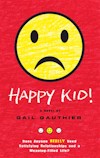
While I was at a writers' retreat yesterday, I learned about a new book called Happy Face by Stephen Emond. The cover and title couldn't help but catch my eye, given how similar they are to Happy Kid!.

Then I read what the book is about--"a shy, artistic boy who decides to reinvent himself as a happy-go-lucky guy after he moves to a new town." Happy Kid! is about a boy who is "friendless, mistakenly taking super-difficult accelerated courses, and infamous for allegedly being involved in a violent "incident" on the bus" "...but a self-help book from his well-meaning mother changes all that. Magically, the book seems to know all about him. And it wants him to improve his life."

Happy Kid! was published four years ago, which is probably a generation in publisher years. Nonetheless, it's hard not to be frustrated.

Happy Face's author even lives in my state.

UPDATE: After fifty minutes or so of exercise and a hot shower, I have started moving on. Also, is the Happy Face cover supposed to be a paper bag? Because that would make it different. Let's say it's a paper bag. Yeah. Ommmm.

Labels: